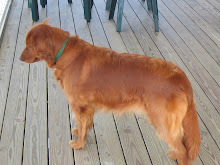
While every bit the wallflower compared to her life-of-the-party friend Shiva, Katy chose not to take a backseat to her in her choice of cancer. The Red Dog's presentation of osteosarcoma all those months ago left us reeling, but nothing prepared us for the "gift" dear, sweet Kate gave to us in December. As I mentioned in a previous post, hemangiosarcoma is the real bad boy member of the canine sarcoma family. My description of the blood-borne beast bears repeating:
"these tumors usually start on the spleen, though they can also originate on the liver, heart and lungs, and they grow quite quickly and like to involve as much of your dog's vascular network as possible. German Shepherd Dogs and Golden Retrievers have the dubious distinction of being the most common victims of this variety, although it can strike any dog at any age."
This stuff is nasty and extremely aggressive. Once diagnosed, choices are limited to immediate surgery (if the tumor's operable) or an all-too short wait for the inevitable end. If it's on the skin (dermal or subcutaneous), that's better. If it's on the spleen, not so good. If it's on the heart, that's bad. In any case, the odds aren't great. The worst aspect of it, however, is the insidious and stealthy nature of its approach.
The first obvious sign dog owners often see of the internal varieties (splenic, heart-based or other) is when their dog collapses from weakness due to blood loss caused by the rupture and subsequent hemorrhage of the mass. Due to their vascular nature, the tumors grow quickly and then burst with devastating results. Many of these dogs die, while a lucky few (like Katy) get better (temporarily) over time. This can provide us a diagnostic window in which the scope and operable/inoperable nature of the cancer can be determined.
The good news (hey, we take it where we find it) is that the surgical removal of a cancerous spleen prior to visible spread to other areas of the body can buy a few to several months of survival...possibly more with chemotherapy.
In the case of heart-based tumors, evidence of cancer elsewhere at the time of discovery is very common. Removal of the mass is also more difficult thanks to its proximity to the heart and its lining. This is a tough diagnosis, but it still may be worth the effort. Surgery and potential chemotherapy should be considered. Take the same approach with tumors found on other organs as well. Listen to your vet, then get a second opinion or have a consult with a surgeon.
As one veterinarian said to us during this trying time: "Why wouldn't you prevent your dog from bleeding to death if you knew you could?"
In hindsight, there were subtle signs that something with Katy was amiss. It began with a gradual reduction in stamina on her walks. We chalked that up to her advancing age (now 12) and arthritic hips, but it was there nonetheless. She also had a harder time standing up, which we also attributed to the aforementioned factors of age and arthritis. Another was an occasional hacking cough, like she was trying to clear something lodged deeply in her throat. In fact, on the night of the tumor's rupture, we were awakened by that cough and actual vomiting.
Finally, she presented obsessive licking behavior. Although not discussed as such by veterinary medical experts, we have seen this occur in multiple dogs with undiagnosed (at that time) cases of cancer. Both Katy and Shiva did just that in the weeks leading up to their diagnoses, and Shiva repeated the behavior with her recent melanoma. We'll give this subject a more in-depth analysis soon.
One other tell-tale sign seen after a rupture is pale or white gum color due to concentration of blood at the hemorrhage site. We were unaware of this symptom, so we did not see it until Dr. Brandi examined her that morning.
After assessing symptoms, veterinarians use a combination of blood work, x-rays and ultrasound screenings to get a better picture of your dog's interior. If the cancer is limited to an operable area, a quick surgical decision should be made. Definitive diagnosis via biopsy is not an option due to the risk of tumor rupture. It must be removed.
After removal, the tumor should be sent for pathology testing. If you're really, REALLY lucky, you'll find out your dog had a benign hemangioma and is cancer-free. Luckily, removing it saved your dog's life, because they rupture just like their malignant cousins. If, on the other hand, it's malignant, be grateful you likely have purchased some more quality time with your dog. Recovery takes 2-4 weeks, after which you should have as much fun as possible while watching for a return of the signs mentioned above.
In summary, don't dismiss the potential symptoms of hemangiosarcoma, especially if your dog presents more than one. It's better to rule-out something like this by spending a little money on diagnostics than to have your dog suddenly die for no apparent reason. We were some of the lucky ones, and we hope what we've shared helps those unlucky enough to face this deadly disease.
Enjoy each extra day for the gift that it is, and never forget that your dogs (most of them, anyway) would do the same for you!




I Know There Are More...
13 years ago